SmartSpend Bulletin™
How to Beat ServiceNow at the Negotiation Table in 2026
ServiceNow knows it’s a top-five vendor and it’s pricing like it. Forced migrations, AI bundling, tier pressure, and compounding uplifts are making renewals harder and more expensive. This bulletin shows procurement leaders how to push back, regain leverage, and negotiate outcomes that reflect real value.
The ServiceNow Commercial Landscape Today
A PLATFORM BUILT FOR STICKINESS
Over the past decade, ServiceNow has systematically expanded from its IT Service Management roots into Risk, HR, InfoSec, and Finance. Today, the vendor is operationally indispensable for the enterprises it serves. This expansion has created three compounding procurement challenges:
- Stakeholder fragmentation: Multiple functional owners now sit at the table, each with independent relationships with ServiceNow account teams and divergent priorities.
- Increased platform stickiness: The deeper the deployment, the harder it becomes to negotiate credibly from an alternative-vendor position.
- License metric complexity: Shifting bundle structures and SKU proliferation create confusion (and compliance risk) for organizations without a dedicated Software Asset Management function.
FOUR CRITICAL CHANGES RESHAPING RENEWALS
Procurement leaders must understand and prepare for four structural shifts in ServiceNow’s commercial model:
- Forced Migrations & Sunset Mandates
IntegrationHub and Automation Engine are transitioning to the Workflow Data Fabric model.
Simultaneously, Software Asset Management SKUs are migrating from per-device to a
Subscription Unit model. These changes introduce both pricing uncertainty and negotiation urgency that ServiceNow account teams are prepared to use as leverage. - The Tier Upgrade Push: Pro Plus & Enterprise Plus
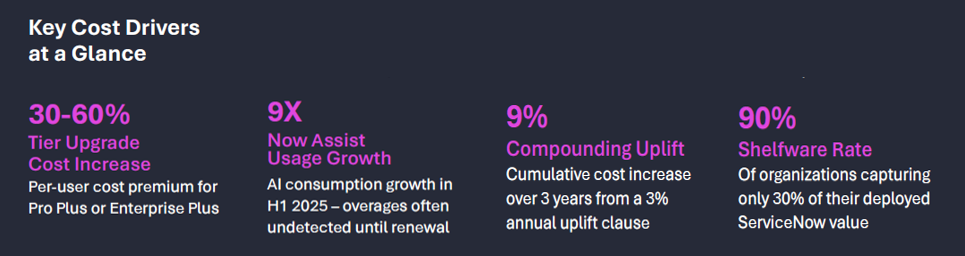
ServiceNow’s generative AI capabilities (Now Assist) are gated behind Pro Plus and Enterprise Plus tiers. Upgrading to these tiers represents a 30 to 60% increase in per-user cost. ServiceNow account teams are applying sustained pressure to move customers up, often framing the upgrade as a business-critical evolution. - Impact Support Tier Changes
Impact Advanced support is no longer offered in 2026. Impact Guided and Impact Total are alternatives, with many customers being forced to move to the costlier Impact Total. This shift is often presented as a service improvement rather than a price increase. - Pricing Uplifts
Unit prices are increasing 8 to 12% even for customers with growing license volumes. More significantly, renewal contracts are increasingly including 3% compounding annual uplift clauses. That generates a cumulative 9%+ cost increase over a standard three-year term on the exact same license footprint.
Where Enterprises Are Overpaying
Understanding where spend leaks occur is a prerequisite to effective negotiation. NPI’s analysis of enterprise ServiceNow contracts identifies four primary overpayment vectors:
ANNUAL UPLIFT CLAUSES
ServiceNow’s historical pattern was to propose 15 to 25% renewal increases and negotiate to approximately 10%. This is currently being replaced by contractual 3% compounding uplift clauses, which may appear modest but accumulate significantly across multi-year terms. Procurement teams that accept these clauses without challenge are embedding structural cost growth into their contracts.
THE “APPROVER TAX”: BUSINESS STAKEHOLDER LICENSES
Managers and approvers who access ServiceNow for reporting, approvals, or workflow participation carry separate license costs. These are frequently added during deployment by IT and functional teams without commercial oversight. The result? Unaccounted spend in the procurement baseline that compounds with every renewal.
SHELFWARE: LICENSES PAID FOR, BUT NOT USED
Industry data suggests that 90% of ServiceNow deployments capture only approximately 30% of their contracted value. Shelfware is not the exception; it is the norm. This creates both a financial exposure and, paradoxically, a negotiation opportunity. Every unused license removed before renewal is one that cannot be cited by the vendor to justify price increases.
THE OVER-CONSUMPTION NARRATIVE AND NOW ASSIST OVERAGES
ServiceNow account teams frequently present “enabled” assets as compliance risk, framing the conversation around what the customer could owe, rather than what is actually deployed. Enabled does not mean actively used. Procurement teams must challenge this framing with independent consumption data.
Now Assist (ServiceNow’s generative AI suite) introduces a new overage risk. AI usage grew 9x in H1 2025 alone, quickly outpacing the annual Assist allotments bundled into Pro Plus and Enterprise Plus licenses. Overage costs are not transparently priced. Organizations may accumulate millions of dollars in AI credit exposure without visibility until the next renewal cycle.
Pre-Renewal Preparation: The Five Imperatives
Regardless of where an organization sits in its renewal timeline, the following preparation disciplines are non-negotiable for achieving a defensible negotiation outcome:
IMPERATIVE 1
Start Earlier Than You Think
9 to 12 months prior to renewal is the minimum effective preparation window. 18 to 24 months is optimal, as it allows procurement to leverage ServiceNow’s own incentive structures (e.g. early renewal credits and expanded scope concessions) in the customer’s favor.
IMPERATIVE 2
Own Your Consumption Data First
Conduct an independent consumption and optimization assessment before engaging ServiceNow. Identify shelfware, inactive users, and enabled-but-unused assets. Do not rely on ServiceNow’s reports. Their data reflects what serves their commercial interests.
IMPERATIVE 3
Build Your Bill of Materials from Demand, Not Last Year’s Invoice
Interview functional product owners for each ServiceNow module. Any SKU without an attached use case and an accountable business owner should not appear in the renewal. The prior year’s invoice is a ceiling, not a floor.
IMPERATIVE 4
Benchmark Against Fair Market Value
SKU-level peer pricing data provides a factual counterpoint to vendor proposals. Without benchmark data, procurement teams are negotiating from a position of information asymmetry.
IMPERATIVE 5
Align Internal Stakeholders Before Engaging the Vendor
ServiceNow account teams are highly skilled at identifying the path of least resistance through an organization. The functional leader who wants AI features, the IT executive who values the relationship, the manager who is behind on deployment. A unified internal front, with a clear communications guide for all stakeholders, is one of the most powerful leverage tools available.
Specific Negotiation Guidance
ON NOW ASSIST AND AI TIER UPGRADES
- Do not upgrade to Pro Plus or Enterprise Plus under time pressure. Understand the full consumption model before committing to a tier change, specifically the number of Assists included per license, per-pack overage cost, and consumption caps.
- Require order form language that explicitly specifies: (1) Assists included per license annually, (2) per-pack overage cost in writing, and (3) a contractual consumption cap with notification obligations before overages accrue.
- Treat AI credits like any other consumption-based resource: model expected usage, apply appropriate buffers, and negotiate overage pricing before signing.
ON ANNUAL UPLIFT CLAUSES
- Challenge 3% compounding clauses explicitly. Request flat-rate uplift caps or, for large-volume renewals, negotiate uplift-free terms in exchange for multi-year commitment.
- If a compounding clause cannot be removed, negotiate an explicit base-year definition to prevent retroactive application.
ON IMPACT SUPPORT CHANGES
- Request a detailed side-by-side comparison of Impact Advanced (discontinued) vs. the proposed replacement tier, including SLA differences, staffing models, and response time commitments.
- If the support migration represents a material cost increase, treat it as a pricing concession opportunity in the broader renewal negotiation.
ON LICENSE OPTIMIZATION
- Complete a full SKU deployment reconciliation before the renewal window opens. Any licensed SKUs with zero or near-zero active deployment should be removed from the renewal or used as credit-generating concessions.
- Segregate “enabled” from “actively deployed” in all internal reporting. Never accept ServiceNow’s compliance risk narrative without validating it against independent consumption data.
Turning Preparation Into Negotiation Power
ServiceNow’s commercial sophistication has grown in direct proportion to its platform breadth. The vendor arrives at every renewal conversation with detailed consumption data, a clear upsell roadmap, and a team of account professionals trained to identify and leverage internal misalignment on the customer side.
Achieving favorable outcomes in ServiceNow deal negotiations isn’t limited to the largest customers with the most perceived leverage. It’s for the organizations that start early, own their data independently, align internally before engaging externally, and approach the commercial conversation with benchmark-supported, use-case-validated positions.
Download the SmartSpend Bulletin™
Share This Bulletin
Interested in Learning
More About NPI's Services?
The organizations
that will succeed in 2026 ServiceNow
negotiations are
those that start
early, own their data, and approach the
vendor with a unified internal front.
Shelfware is the
flagrant foul of
ServiceNow cost
management.
Every unused
license removed
before renewal is
one that cannot be cited by the vendor to justify price increases.
Time pressure
should not dictate
ServiceNow
upgrades –
especially with
the inclusion of AI functionality.
Cost forecasting is complicated and the risk for unbudgeted
spend is significant.
Take time to
understand cost
layers, model
expected usage
against multiple
scenarios, and
negotiate overage pricing.
About NPI
NPI is the premier provider of data, services and tools to help large enterprises identify and eliminate overspending on IT purchases. NPI delivers transaction-level price benchmark analysis, license and service optimization analysis, and vendor-specific negotiation intel that enables IT buying teams to drive material savings and measurable ROI. NPI analyzes billions of dollars in spend each year for clients spanning all industries that invest heavily in technology. NPI also offers software audit, audit defense, and asset management services.